
Posey County Divorce Records
Divorce records in Posey County are filed with the Circuit Court Clerk in Mt. Vernon and are accessible to the public under Indiana's open records laws. This page explains how to find, request, and understand divorce case files in Posey County.
Posey County Quick Facts
Posey County Circuit Court Clerk
The Circuit Court Clerk, Kay Kilgore, keeps all divorce records filed in Posey County. The office handles case filings, document requests, and fee collection. You can visit, call, or mail a request to get copies of divorce decrees and case documents.
Office Address: 300 Main St, Room 115, Mt. Vernon, IN 47620
Phone: 812-838-1306
Clerk: Kay Kilgore
To request records in person, go to Room 115 during normal business hours. Bring a photo ID and the case number if you have it. Staff can help you search by name and approximate year if you don't have the exact case number. Copy fees are $1.00 per page. Certified copies cost an extra $3.00 to $5.00.
Mail requests should include the full names of both parties, the approximate year of the divorce, and a check or money order for copies. The clerk will contact you if the fee needs to be adjusted. Allow extra time for mail requests since processing can take one to two weeks.
Search Divorce Records Online
Indiana's statewide case search system, MyCase, lets you look up Posey County divorce cases from home. The portal shows case numbers, party names, filing dates, and hearing schedules for cases in the court system.
The Indiana Courts website provides a direct link to the search portal. You can search by name, case number, or court type. MyCase covers most civil and family court cases filed since the county moved to the Odyssey case management system.
Visit mycase.in.gov to search Posey County divorce records online. The system is free to use and available around the clock. Keep in mind that sealed records and older paper files may not appear in the online system.
The Indiana Courts directory at in.gov/courts/directory also has contact details for local court offices if you need to reach the clerk directly or confirm hours before visiting.
The MyCase portal shows basic case data. If you need full document copies, including the actual divorce decree or property settlement agreement, you'll need to request those from the clerk's office. Online access shows the case record but not scanned document images for most older cases.
You can search for Posey County divorce cases through Indiana's MyCase portal, which covers circuit and superior court filings statewide.
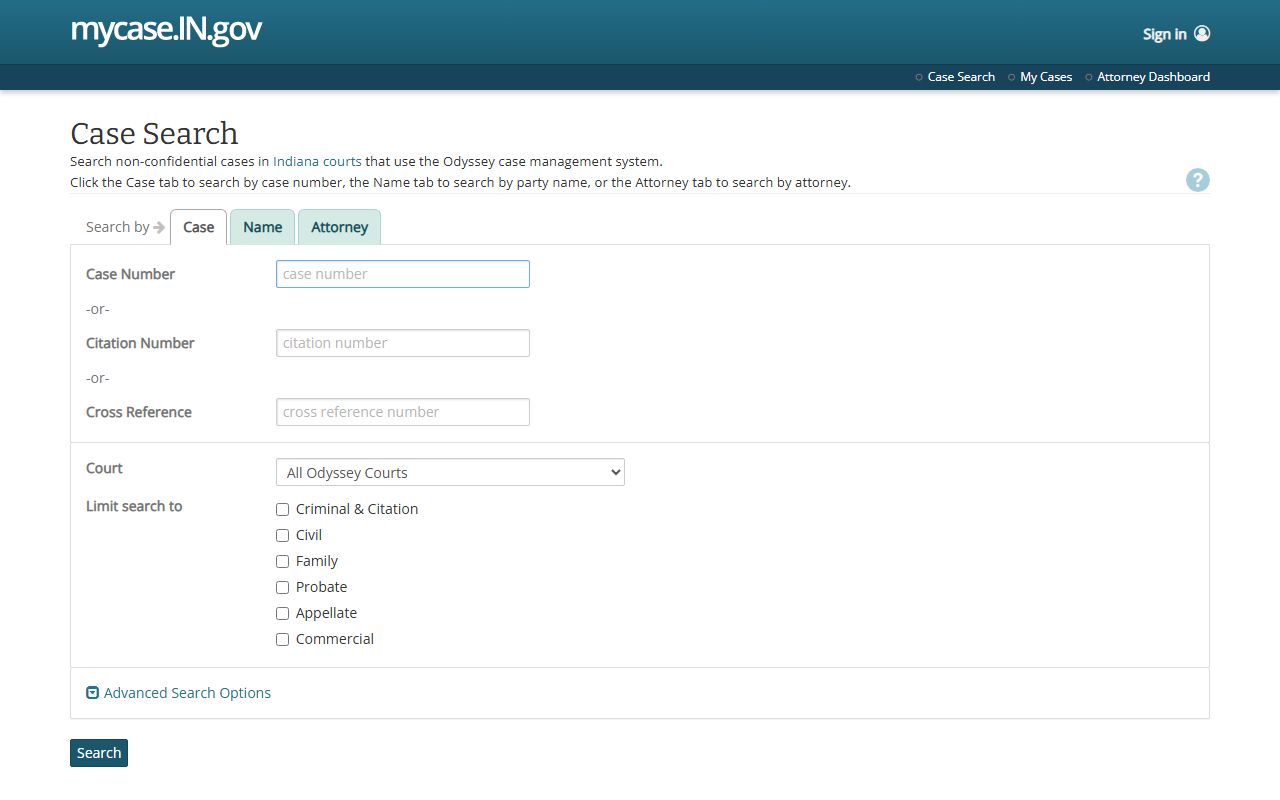 The portal is updated regularly as clerks enter new case activity, so recent filings typically appear within a few business days of being processed.
Filing for Divorce in Posey County
To file a divorce in Posey County, at least one spouse must have lived in Indiana for six months and in Posey County for three months before filing. This residency requirement is set out in Indiana Code 31-15-2-6.
The filing fee at the Posey County Circuit Court is around $157 to $177 depending on the type of case. If there are children involved or contested issues, additional fees may apply. Ask the clerk's office for the current fee schedule before you file.
Indiana law requires a 60-day waiting period before a divorce can be finalized. This period starts from the date the petition is filed. Even if both parties agree on all terms, the court cannot grant the divorce until 60 days have passed. This rule comes from Indiana Code 31-15-2-10.
Uncontested divorces, where both spouses agree on property, debts, and any custody matters, typically move faster and cost less than contested cases. The couple can file a settlement agreement with the court and appear at a final hearing once the waiting period ends. The clerk's office does not provide legal advice, so you may want to speak with an attorney or contact Indiana Legal Help.
What Divorce Records Contain
A divorce case file in Posey County can include several different documents depending on the case. The petition for dissolution is the starting document. It lists both parties, the grounds for divorce, and what each party is asking the court to order.
Other documents in the file may include financial disclosures, property inventories, child custody agreements, parenting plans, and the final divorce decree. The decree is the court order that officially ends the marriage. It states the terms of the divorce as the court approved them.
Some documents in a divorce file can be sealed by court order, especially those involving minor children or sensitive financial data. If a document is sealed, you cannot get a copy without a court order even if the rest of the case file is public.
If you need to prove a divorce happened, a certified copy of the decree is the standard document used. Lenders, government agencies, and other courts typically accept a certified copy as proof. The clerk charges an additional fee for certification, usually $3.00 to $5.00 on top of the copy fee.
Residency and Legal Requirements
Indiana is a no-fault divorce state. You do not need to prove wrongdoing to get a divorce. The standard ground is "irretrievable breakdown of the marriage," which simply means the marriage cannot be saved. Courts in Posey County apply this standard in most cases.
If one spouse contests the divorce or disputes the terms, the case may go through mediation or a full trial. Both parties present evidence and the judge decides unresolved issues like property division and custody. Contested cases take longer and cost more than uncontested ones.
For help understanding the process without paying full attorney fees, Indiana Legal Help offers free legal information and resources. Visit indianalegalhelp.org for guides on divorce, custody, and court procedures in Indiana.
The Indiana Courts public records request page at in.gov/courts/public-records/how-to-request also has information on how to ask for records from any Indiana court, including what to include in your request and what fees to expect.
Older and Historical Divorce Records
Posey County has records going back to the county's early years. Older files may be on paper or microfilm and are stored in the clerk's office or in county archives. If you're looking for a divorce that happened decades ago, the clerk can check the older ledgers and indexes.
The Indiana State Library and Indiana State Archives also hold copies of some older court records and vital records. If the clerk's office cannot locate a very old record, the state library is a good next step. Genealogy researchers often use these sources when tracing family history.
For records from the 1950s onward, the clerk's office in Mt. Vernon is the primary source. Staff can search by name and year. If you know the approximate decade, that helps narrow the search. Some older indexes are handwritten ledgers that staff have to search manually.
Related Records and Resources
Divorce cases sometimes connect to other record types. Property transfers that result from a divorce show up in the county recorder's office. If the court ordered a name change, that appears in the court record and may also be noted in vital records held by the Indiana Department of Health.
Child support orders from a divorce case are enforced through the Indiana Child Support Bureau. If a support order was modified after the original divorce, those records are also in the court file under the same case number.
The Indiana State Department of Health maintains a divorce registry with statewide data. This registry does not provide copies of decrees but can confirm that a divorce occurred. The clerk's office is the correct place to get an actual copy of the divorce decree.
If you are dealing with a divorce that involved property in multiple counties, you may need to check court records in each county where filings occurred. The primary case will be in the county where the petition was filed, which is Posey County if that's where the parties lived.
Nearby Counties
Divorce records for neighboring counties are kept by their respective circuit court clerks. If you are unsure which county handled a case, check the county where the parties lived at the time of filing.