
Vanderburgh County Divorce Records Search
Divorce records in Vanderburgh County are filed with the Clerk of Courts in Evansville and are public documents under Indiana law. This page covers how to find, request, and use divorce case records in Vanderburgh County, which serves Evansville and surrounding communities in southwestern Indiana.
Vanderburgh County Quick Facts
Vanderburgh County Clerk of Courts
Clerk Dottie Thomas handles all divorce case records for Vanderburgh County. The clerk's office is located in downtown Evansville at the civic center. It is the official place to file a divorce and to request certified copies of case documents. The office handles in-person, phone, and mail requests.
Office Address: 1 NW Martin Luther King Jr. Blvd, Room 216, Evansville, IN 47708
Phone: 812-435-5160
Clerk: Dottie Thomas
For in-person visits, bring a photo ID and any case information you have. Staff can search by name and approximate year if you don't have a case number. Copy fees are $1.00 per page. Certified copies add $3.00 to $5.00 per document.
Mail requests should include the full names of both parties, the approximate year the divorce was filed, and payment by check or money order. The clerk will contact you if the fee needs adjustment before sending documents. Allow one to two weeks for mail request processing.
Vanderburgh County also has an Official Records Online system that may provide access to some court records. Check with the clerk's office for current access options and whether specific divorce case documents are available through that system.
The Indiana Courts website has an official Vanderburgh County page with clerk contact details and local court information.
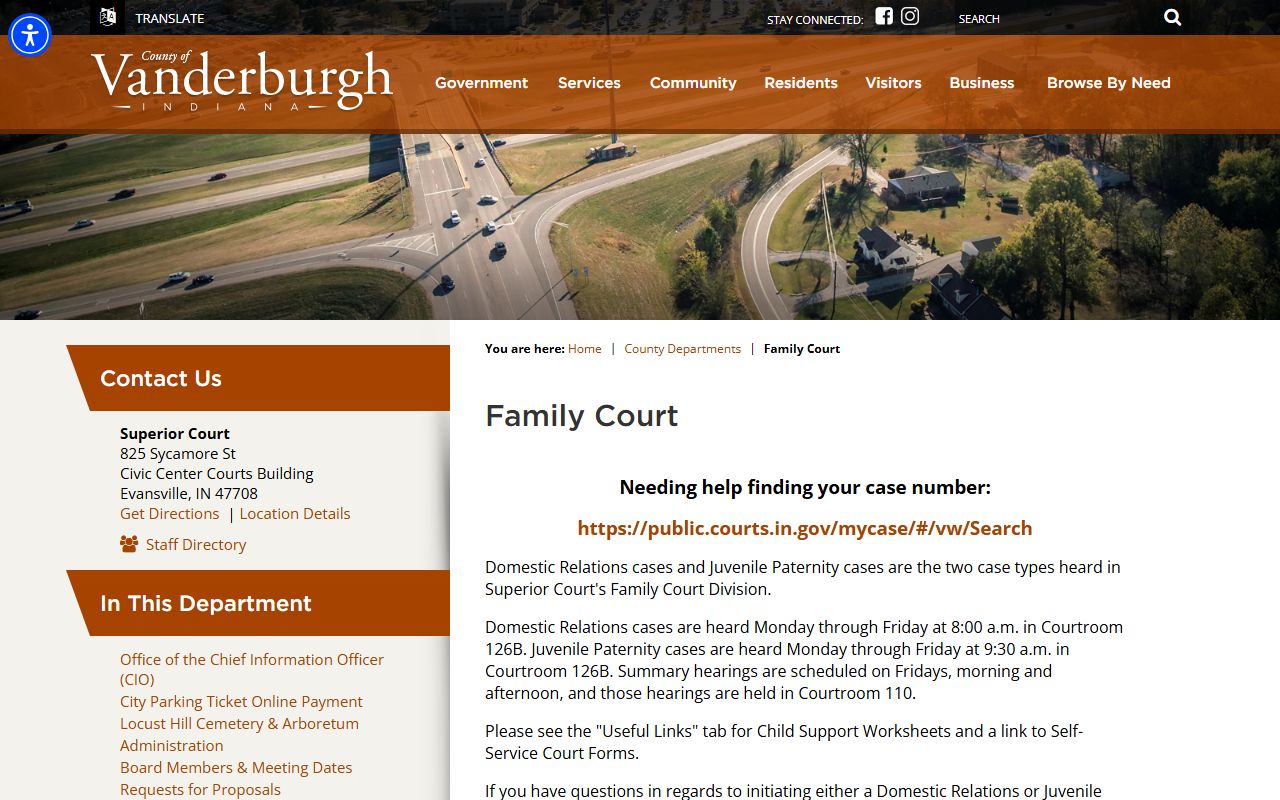 This is the official state page for Vanderburgh County court contacts and is kept current with clerk hours and local procedures.
Online Case Search
Indiana's MyCase portal at mycase.in.gov lets you search Vanderburgh County divorce cases from any device. The portal is free and available at any time. Search by party name or case number to see case status, filing dates, and court hearing information.
MyCase covers cases filed in the Odyssey system. Older paper records from before the county moved to electronic filing may not appear in the portal. For those, contact the clerk's office directly for a manual search.
The portal shows the case record and docket entries but does not provide downloadable copies of actual case documents. To get the divorce decree or other filed papers, contact the clerk's office and request copies with the applicable fee payment.
The Indiana Courts directory at in.gov/courts/directory has current contact information for the Vanderburgh County clerk's office and other local courts serving Evansville and the surrounding area.
Filing for Divorce in Vanderburgh County
To file for divorce in Vanderburgh County, at least one spouse must have lived in Indiana for six months and in Vanderburgh County for three months before filing. This requirement is in Indiana Code 31-15-2-6.
The petition is filed at Room 216, 1 NW Martin Luther King Jr. Blvd. Filing fees run from $157 to $177 depending on the type of case. Confirm the exact current fee with the clerk's office before filing. Cases involving children or contested issues may have additional charges.
After filing, Indiana law requires a 60-day waiting period before the divorce can be finalized. This rule is set by Indiana Code 31-15-2-10. The 60 days run from the filing date. The court cannot issue the final decree until that period ends, even if both spouses are in complete agreement.
Indiana uses a no-fault divorce system. You don't need to prove that one spouse caused the marriage to fail. Irretrievable breakdown of the marriage is the standard grounds. Uncontested cases where both parties agree on property, debts, and custody typically move through the court quickly after the waiting period. Contested cases may require mediation or a full court hearing.
What's in a Vanderburgh County Divorce File
A divorce case file in Vanderburgh County includes the petition for dissolution, the response from the other spouse, financial disclosure forms, property settlement agreements, and the final divorce decree. Cases with children also include parenting plans and any custody and support orders.
The final divorce decree is the most commonly requested document. It is the court's official order ending the marriage. Certified copies are accepted by banks, government agencies, and courts in other states as legal proof that the marriage ended.
Some materials in a divorce file may be sealed by court order. Financial records and documents involving minor children are sometimes restricted from public access. Sealed items require a court order to access even if the rest of the case file is open to the public.
Name changes granted as part of a divorce are noted in the final decree. A certified copy of the relevant portion of the order can be used with the Indiana BMV, Social Security Administration, and passport agencies to update identification documents.
Historical and Older Records
Vanderburgh County has maintained divorce records for many decades. Older case files are on paper or microfilm at the clerk's office. Staff can manually search older indexes if you provide names and an approximate year or date range. Very old handwritten records may take longer to locate.
The Indiana State Library and Indiana State Archives hold microfilm collections of older Indiana county court records. If the local clerk cannot find a very old record, those institutions are a useful backup for genealogy research and historical inquiries.
For records from the mid-20th century onward, the Vanderburgh County clerk's office in Evansville is the primary source. Most records from that era are indexed and can be searched by name. Staff can estimate copy costs before you commit to a formal request.
Legal Help and Resources
The clerk's office handles filings and requests but cannot provide legal advice. For free guidance on Indiana divorce law, Indiana Legal Help at indianalegalhelp.org has plain-language guides on divorce, custody, and property matters.
The site covers the full divorce process, including what forms to file, how court hearings work, and how Indiana judges handle disputes over property and children. It is useful for people navigating a divorce without a full-time attorney.
The Indiana Courts public records page at in.gov/courts/public-records/how-to-request explains how to request court records formally, including what to include in your request and what fees to expect.
Indiana Legal Services may provide free legal help to qualifying residents in Vanderburgh County. Local legal aid organizations and bar associations in Evansville may also offer assistance for family law matters.
Related Records
Divorce proceedings in Vanderburgh County can generate records in other offices. Property transferred through a divorce is recorded at the Vanderburgh County Recorder's office. Deed changes and mortgage releases tied to the divorce show up in recorder records once the court order is issued.
Child support orders from a divorce are tracked through the Indiana Child Support Bureau. Post-divorce modifications to custody or support are filed in the clerk's office under the original case number and remain part of the public record.
The Indiana State Department of Health maintains a statewide divorce registry that can confirm a divorce occurred in Indiana but does not issue certified document copies. For certified copies, contact the Vanderburgh County Clerk of Courts at 1 NW Martin Luther King Jr. Blvd. in Evansville.
Cities in Vanderburgh County
Evansville is the county seat and the largest city in Vanderburgh County. It has its own page with additional local resource information.
Nearby Counties
Divorce records are filed in the county where one of the parties lived at the time of filing. Contact neighboring county clerks if you need to verify where a specific case was handled.